RESEARCH • FEBRUARY 9, 2026
The UAE Blockchain Ecosystem
Where Technology, Policy,
and Capital Converge
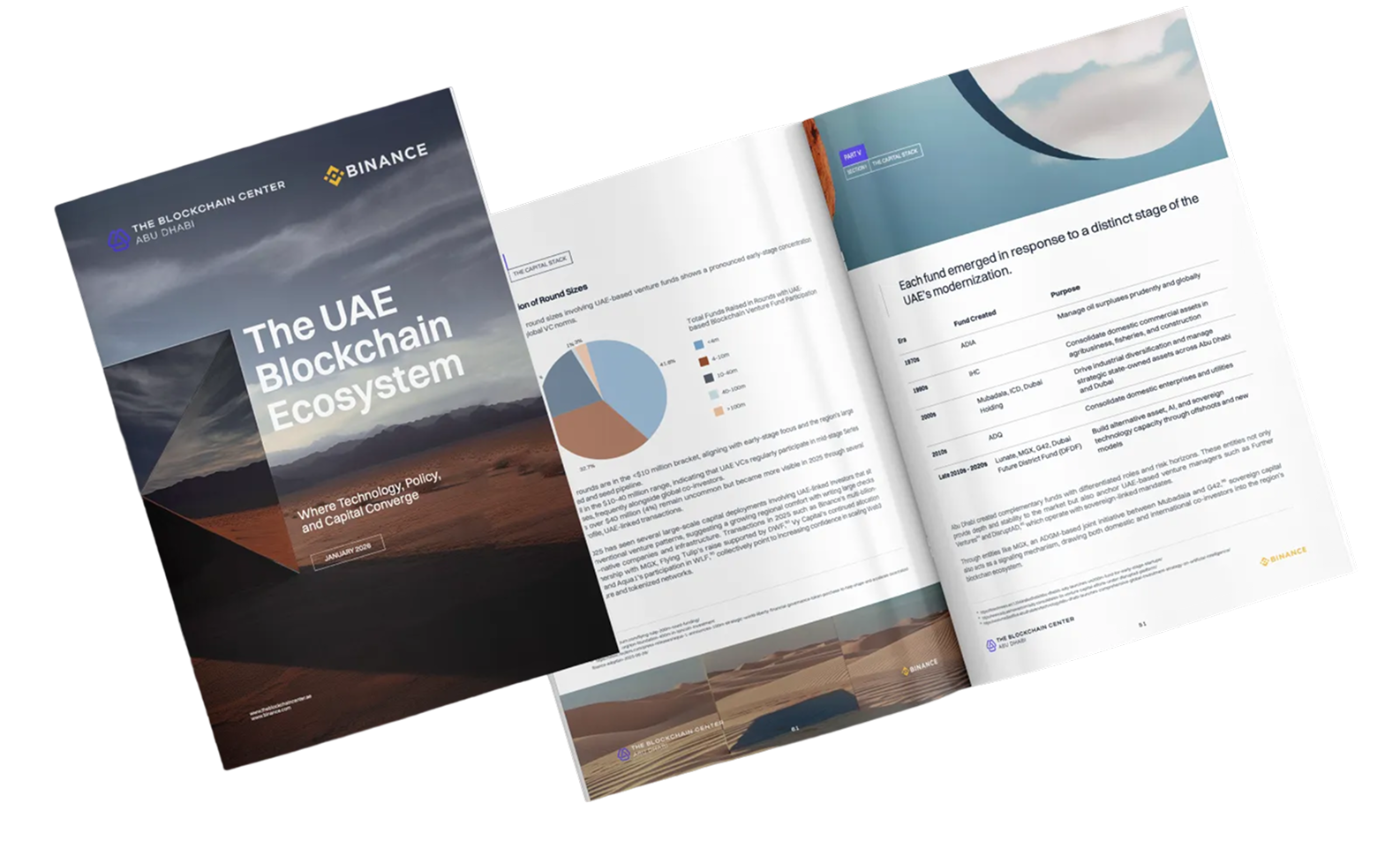
A comprehensive institutional analysis, developed in collaboration with Binance, examining how
the UAE has moved from regulatory experimentation to production-scale blockchain infrastructure.
A comprehensive institutional analysis, developed in collaboration with Binance, examining how the UAE has moved from regulatory experimentation to production-scale blockchain infrastructure.




.png)



Abdulla Al Dhaheri
CEO

Justin Lim
COO

Calvin Lu
CBO

Konstantin Sinev
Head of Marketing & Events
Head of Marketing & Events

Dana Abu Salem
Executive Assistant
Who This Report Is For

Policymakers & Regulators
Understanding how layered regulatory frameworks enable supervised blockchain markets and institutional participation.

Institutional Investors
Assessing market structure, risk considerations, and long-term opportunity across the UAE digital asset ecosystem.

Banks & Financial Institutions
Exploring tokenization, custody, settlement, and integration of blockchain into regulated financial infrastructure.

Founders & Operators
Identifying licensing pathways, operating models,
and jurisdictional considerations for building in the UAE.

Enterprise & Government Leaders
Evaluating real-world blockchain deployments across payments, trade, identity, and public-sector systems.


Selected Organizations
Referenced in the Report



Report Contents
Executive Summary


An overview of the report’s core findings, outlining how the UAE has moved from regulatory design and controlled experimentation to large-scale implementation of blockchain across payments, settlement, capital markets, government systems, and commercial activity, supported by layered regulation and sovereign-aligned capital.
Part I: A Contextual Overview of the UAE
Provides economic, political, and institutional context for understanding why the UAE has emerged as a leading environment for blockchain adoption, including its federal structure, emirate-level autonomy, business-oriented governance model, and diversified, non-oil-driven economy.
Part II: The Promise of Blockchain for the UAE
Examines how blockchain aligns with national strategic priorities such as financial modernization, digital government, trade efficiency, and global competitiveness, positioning distributed systems as enabling infrastructure rather than speculative technology.
Part III: The UAE’s Evolving Blockchain Regulatory Landscape
Details the multi-layered federal and emirate-level regulatory architecture governing blockchain and virtual assets, and explains how coordinated oversight enables institutional participation across payments, custody, tokenization, and market infrastructure.
Blockchain Regulation in the UAE: Three Distinct Phases
Traces the progression from early sandbox experimentation to formalized regulatory frameworks, to mature supervisory regimes focused on operating markets and licensed institutions.
Pathways for Blockchain Companies
Outlines licensing and operating options available to blockchain companies across mainland UAE, financial free zones, and specialized virtual asset regimes, highlighting practical considerations for market entry.
Part IV: Current State of UAE Blockchain Innovation
Assesses the present level of blockchain deployment across financial services, government, and enterprise platforms, showing how distributed ledger technology is increasingly embedded into production systems.
Key Use Cases
Explores major application areas, including payments and settlement, trade finance and logistics, tokenization, digital identity, and public-sector services, supported by examples of live or near-production implementations.
Other Use Cases
Covers additional and emerging applications across sectors such as energy, commodities, data sharing, and specialized enterprise workflows.
Part V: Market Development and Institutional Landscape
Maps the institutional composition of the ecosystem, including regulated exchanges, custodians, payment providers, infrastructure vendors, tokenization platforms, banks, and multinational technology firms.
The Capital Stack: Sovereign, Domestic VC, and Global VC
Analyzes how sovereign and quasi-sovereign funds, regional venture capital, family offices, and global investors collectively anchor and finance ecosystem growth.
Infrastructure and Enablement Layer
Describes the foundational components that support institutional markets, including custody, settlement rails, compliance tooling, identity, and integration with traditional financial systems.
The Social Layer: Events and Conferences
Explains how the UAE’s growing role as a convening hub for digital asset and financial technology events reinforces its position in global market formation.
Conclusion: The Era of Infrastructure Utility
Concludes that the UAE blockchain ecosystem has entered a phase where utility, coordination, and infrastructure development outweigh experimentation, with future challenges centered on interoperability and cross-jurisdictional alignment.

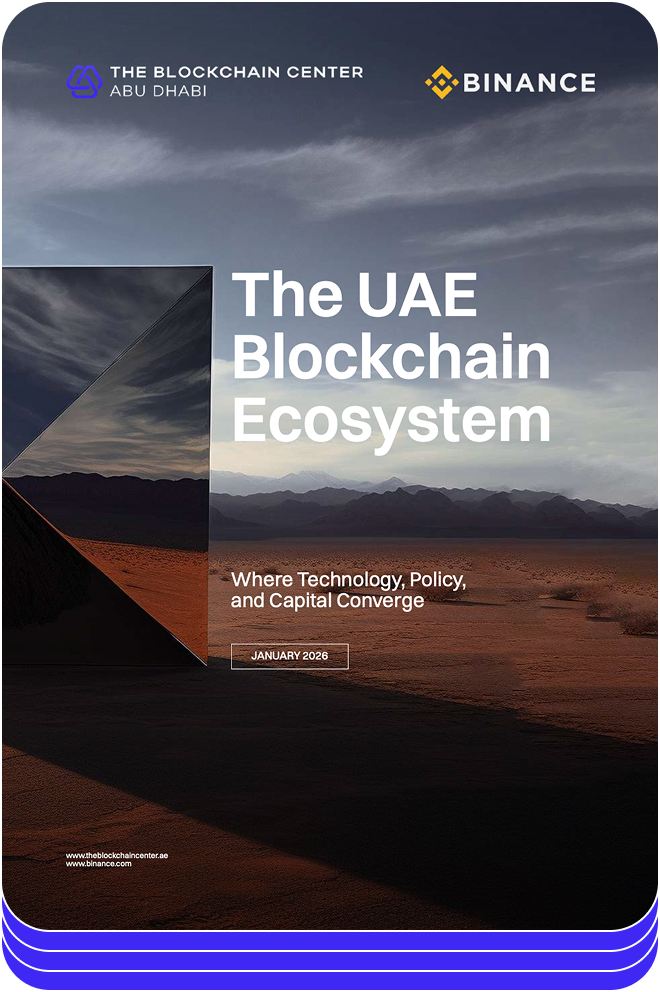
The UAE Blockchain Ecosystem Where Technology, Policy,
and Capital Converge
This report examines how the UAE has built a regulated, institution-ready blockchain ecosystem by aligning policy, capital, and market infrastructure. It traces the shift from pilot programs to supervised deployment across payments, custody, tokenization, and capital markets, and explains how federal and emirate-level regulators and free zones shape market structure and risk controls. It also reviews real-world use cases in government, finance, and enterprise, mapping key institutions and the conditions required to scale responsibly. A practical read for policymakers, investors, banks, and operators navigating the UAE’s digital asset market. The report also shows why this approach matters as a blueprint for scaling innovation without sacrificing compliance.